Reviewing Kawaii School Supplies Vector Art
As a designer who spends half my life staring at digitized paths and the other half pulling threads out of bobbin cases, I have learned to be skeptical of cute. Cuteness is easy to draw but notoriously difficult to stitch. When I first opened the Kawaii School Supplies Cute Vector Art package, my initial reaction was cautious optimism. The black and white line work looked clean on screen, but screen clarity is a liar. The real test is always how those lines translate into thread, tension, and texture.
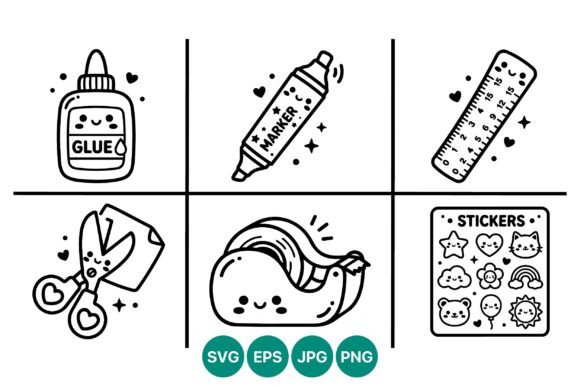
This collection features smiling glue bottles, markers, rulers, scissors, tape dispensers, and sticker sheets with expressive faces. It falls under the category of Illustrations and Graphics, which immediately tells me that these are likely vector-based source files rather than pre-digitized embroidery formats. For an experienced embroiderer, this distinction is critical. It means we are not just loading a file and hitting start; we are making design decisions about how to interpret these graphics for the needle.
The Aesthetic Appeal and First Impressions
The mood here is undeniably cheerful. The kawaii style relies on simplified shapes and anthropomorphic features—eyes and smiles on inanimate objects—which creates an instant emotional connection. For a handmade product, this is gold. Customers do not just buy a tote bag; they buy the feeling of nostalgia and joy that a smiling pair of scissors evokes. The visual personality is soft and approachable, making it ideal for back-to-school promotions, teacher appreciation gifts, or nursery decor.
However, from a technical standpoint, the simplicity of the black and white outline style presents both an opportunity and a challenge. In embroidery, we cannot simply "print" a line. We must choose between a running stitch for a sketch-like effect, a satin stitch for bold definition, or a fill stitch if we decide to color in the characters. The lack of pre-defined shading in the source art gives us creative freedom, but it also places the burden of depth and dimension squarely on our shoulders.
Real-World Application: The Custom Tote Bag Scenario
To truly evaluate this design, I imagined a specific project: a canvas tote bag design for a local boutique selling teacher supplies. Canvas is a sturdy fabric, but it has a visible weave. If I were to use the ruler or marker elements from the Kawaii School Supplies Cute Vector Art set, I would need to consider scale. A tiny ruler might get lost in the fabric texture, looking like a glitch rather than a design element.
In this scenario, I would likely enlarge the main characters, such as the glue bottle or the tape dispenser, to ensure the facial expressions remain clear. The eyes and mouths are small details. If the stitch density is too low, these features might look sparse. If it is too high, the fabric could pucker. I would recommend using a medium-weight cutaway stabilizer to support the stitching, ensuring the finished product lies flat and professional.
For sweatshirt embroidery, the approach changes. Fleece and cotton blends are thicker and softer. Here, the sharp lines of the vector art might need to be softened. I would avoid long running stitches that could sink into the pile of the fabric. Instead, I might opt for a slightly wider satin stitch border around the characters to make them pop against the textured background. This turns a simple graphic into a tactile, premium-feeling personalized gift.
Navigating Technical Challenges
While the charm of these design assets is high, there are areas where caution is required. The scissors and ruler have straight, geometric lines. In embroidery, long straight lines are prone to shifting or looking uneven if the tension is not perfect. When working on curved surfaces like a embroidered patch or a cap, these straight edges can distort. I would advise breaking up long lines into shorter segments or using a slight zigzag pattern to maintain structural integrity.
Another consideration is the "small hoop size" constraint. If you are working with a 4x4 inch hoop, you cannot fit the entire sheet of stickers and all the school supplies in one go. You must curate. Pick one hero character, like the smiling marker, and let it stand alone. Overcrowding a small space with multiple kawaii elements will result in a muddy, indistinct finished product. Less is often more when dealing with intricate vector illustrations.
Color choice is also pivotal. Since the source art is black and white, you have total control over the thread colors. However, high contrast is key. A dark blue thread on a black shirt will vanish. For custom apparel, always test your color combinations on scrap fabric first. I frequently create black and white mockups to check for value contrast before committing to expensive threads. This step saves time and ensures the design reads clearly from a distance.
Commercial Viability for Etsy Sellers and Makers
For Etsy sellers and small shop owners, this collection offers versatility. It fits seamlessly into the "back to school" niche, which is a massive revenue driver in late summer. But its utility extends beyond September. The kawaii aesthetic is evergreen for stationery lovers, planners, and organizational enthusiasts. You could use these graphics for holiday embroidery projects by adding seasonal elements, or for year-round baby embroidery items like bibs and burp cloths, provided you scale them appropriately for smaller garments.
When creating printable mockup previews for your online store, remember that the digital image will look sharper than the stitched reality. Be honest in your product photos. Show close-ups of the stitching so buyers understand the texture and quality they are purchasing. This builds trust and reduces returns. A well-executed machine embroidery design derived from these vectors can elevate a basic item into a boutique-quality piece.
Practical Designer Notes for Best Results
Before you commit to a large production run or a client order, follow these practical steps:
- Test on Scrap Fabric: Always stitch out a sample on the exact fabric type you plan to use. Check for puckering, thread breaks, and registration issues.
- Check Stitch Density: If you are digitizing these vectors yourself, ensure the density is appropriate for the fabric. Delicate fabrics need lighter density; heavy fabrics can handle more coverage.
- Verify Licensing: The product description mentions a ZIP folder with graphics. Confirm whether the license allows for commercial use of the digital embroidery file or the finished physical items. Never assume.
- Inspect Small Details: Zoom in on the eyes and smiles. Ensure they are large enough to be stitched cleanly. Tiny details often need to be simplified or enlarged for embroidery.
- Consider Fabric Texture: On textured fabrics like towels or linen, increase the stitch width slightly to ensure coverage and visibility.
In conclusion, the Kawaii School Supplies Cute Vector Art is a strong foundation for creative embroidery projects. It is not a plug-and-play solution, but rather a versatile set of Illustrations that rewards thoughtful digitization and careful execution. For the craft business owner willing to put in the prep work, these designs can become standout bestsellers. They offer the perfect blend of whimsy and professionalism, provided you respect the technical limitations of the embroidery machine and the fabric. Treat these vectors as a starting point, not the final word, and you will create pieces that customers love to wear, use, and gift.