Retro Tech and Animal Collage: A Designer’s Review
As a designer who has spent countless hours digitizing files and testing them on various machines, I have learned that not every graphic translates well to thread. When I first opened the Retro Tech and Animal Collage, my immediate reaction was one of cautious optimism. The concept—a whimsical blend of vintage technology and animal silhouettes rendered in a halftone style—is trendy, but trendiness often comes with technical pitfalls in embroidery. This review breaks down how this specific set of Illustrations and Graphics holds up when moved from the screen to the hoop.
First Impressions and Visual Mood
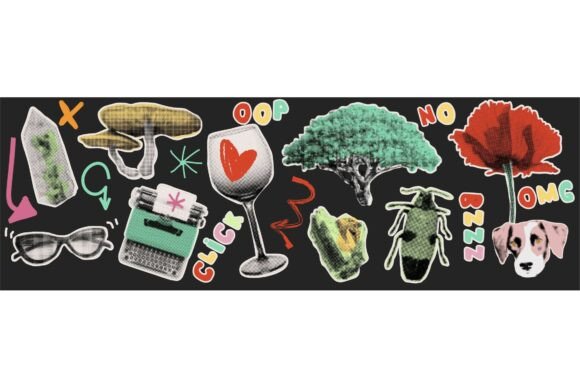
The aesthetic here is distinctly nostalgic. We are looking at dog silhouettes paired with typewriters and "click" lettering, all treated with a halftone effect. For an embroidery project, halftones are notoriously tricky. They rely on the spacing of dots to create shading, which can easily turn into a muddy mess if the stitch density is too high or the thread choice is poor. However, the clean lines of the silhouettes provide a strong anchor. The mood is playful yet sophisticated, making it ideal for creative branding or a curated scrapbook sticker set vibe. It feels like something you would see in a modern boutique rather than a generic big-box store.
The layout is neatly organized, which is a significant plus. As an experienced reviewer, I appreciate when elements are separated logically. This allows me to isolate the dog, the typewriter, or the text depending on the project requirements. It gives me flexibility, which is crucial when working with custom apparel or varied hoop sizes.
Real-World Application: The Tote Bag Test
To truly evaluate a design, you must imagine it on a finished product. I visualized this design on a heavy canvas tote bag. This is a popular item for Etsy sellers and small shop owners. The retro theme pairs beautifully with natural cotton or linen fabrics. In this scenario, the typewriter silhouette serves as a focal point, while the dog adds a layer of warmth and approachability.
If I were stitching this for a client’s handmade product, I would likely use a satin stitch for the bold outlines of the typewriter and the dog to ensure crisp edges. The halftone areas, however, would require careful attention. I would opt for a lighter fill stitch or even a running stitch pattern to mimic the dot effect without creating excessive bulk. On a tote bag, which needs to be durable and foldable, heavy stitch density is the enemy. It can cause the fabric to pucker and make the bag stiff. The Retro Tech and Animal Collage works here because the silhouettes allow for negative space, balancing out the denser halftone regions.
Apparel and Custom Gifts
Moving beyond bags, let’s consider sweatshirt embroidery. This is a huge market for personalized gifts and holiday embroidery. A crewneck sweatshirt provides a large, stable canvas. Here, the scale of the design can be increased to showcase the details of the "click" lettering. However, one must be wary of the fabric texture. Fleece and French terry have a pile that can swallow small details. If the halftone dots are too small, they will disappear into the fabric loops.
For baby embroidery, such as on a onesie or a nursery decor pillow, I would exercise caution. The typewriter element might be too complex for such a small scale. Instead, isolating the dog silhouette could create a charming, simple motif. Always test the design on scrap fabric first, especially when working with stretchy or thin materials. Using a proper stabilizer is non-negotiable here. A cut-away stabilizer would provide the necessary support for the varying densities within the collage, ensuring the finished product maintains its shape after washing.
Technical Challenges and Considerations
While the design is visually appealing, there are areas where it demands respect from the operator. Halftone styles in embroidery files are not plug-and-play. They require precise thread color contrast. If you choose thread colors that are too similar in value, the halftone effect will vanish, leaving you with a solid block of color that lacks depth. I recommend testing the design in black and white mockups first to check the contrast levels before committing to expensive threads.
Another consideration is the hoop size. Since the elements are scalable vector formats, you might be tempted to shrink the entire collage to fit a small 4x4 hoop for an embroidered patch. I advise against this unless you verify the minimum stitch length. Tiny lettering and detailed corners can become indistinguishable blobs if scaled down too far. For caps and curved surfaces, the density becomes even more critical. High-density areas on a curved cap can cause shifting and distortion. It is better to simplify the design for hats, perhaps using just the dog silhouette and omitting the complex halftone background.
Commercial Viability and Branding
For craft business owners and digital product sellers, the versatility of this design is its strongest asset. It fits seamlessly into the current trend of retro-modern aesthetics. Whether you are creating printable mockups for your online store or actual commercial embroidery items, the cohesive look helps build brand consistency. Customers trust handmade products that look professional, and a well-executed halftone design signals a higher level of skill.
However, always confirm licensing before selling finished items or digital products. Just because a file is labeled as a graphic does not automatically grant commercial rights. Check the specific terms provided with the download. Assuming you have the right license, this design can elevate your Etsy listings. It stands out from the typical floral or monogram designs, offering something unique for buyers looking for quirky, intellectual, or pet-loving themes.
Practical Designer Notes
Before you load this onto your machine, keep these practical tips in mind:
- Check Stitch Density: Halftones can be dense. Use your software to view the stitch count and density map. If it looks too heavy, consider reducing the density or changing the stitch type to a lighter fill.
- Thread Selection: Choose high-quality threads with a slight sheen to enhance the visual appeal. Matte threads might make the halftone look flat.
- Fabric Testing: Always run a test on the actual fabric you plan to use. What looks good on cotton might pucker on polyester.
- Stabilizer Choice: Match your stabilizer to your fabric. Heavy fabrics need less support, but the complex nature of this collage benefits from a medium-weight cut-away.
- Scale Appropriately: Do not assume scalability means infinite flexibility. Respect the minimum detail size of your machine and needle.
In conclusion, the Retro Tech and Animal Collage is a strong contender for designers who understand the nuances of embroidery. It is not a beginner-friendly "click and stitch" file due to the halftone complexity, but for those willing to adjust settings and choose materials wisely, it offers a distinctive look. It bridges the gap between digital art and tactile craft, providing a unique option for sweatshirt embroidery, tote bag designs, and boutique branding. With careful execution, it can become a standout piece in your portfolio of finished products.